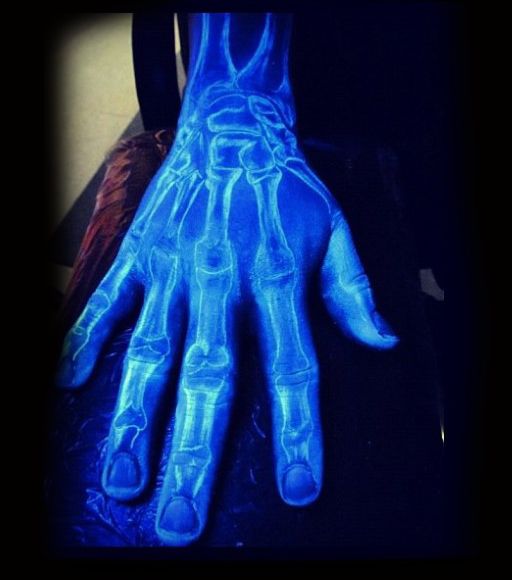
Maybe you love all things glow-in-the-dark or maybe you just love having a secret. Whatever the reason, if you’re considering getting a UV tattoo — aka a tat with ink that’s only visible under a black light — there are a few things to know before making the leap. Black lights are also known as ultraviolet (UV) lights, and are often found in settings like nightclubs and raves. Black light tattoos are created using UV-reactive ink, which makes it nearly invisible in plain daylight, but visible under an ultraviolet bulb.
These transfixing tats aren’t new: Tattoo artist and co-owner of Brooklyn Tattoo Adam Suerte says UV and glow-in-the-dark tattooing gained popularity in the ‘90s, likely due to the craze for all things raves and neon. “This seemed a natural fad with the emerging counterculture,” he tells Bustle. Still, UV tattoos haven’t totally faded out of the scene, with celebrities like Zayn Malik and Lil Wayne sporting them.
What’s cool about black light tattoos is the creative, otherworldly twist they can add to your body: The UV ink can be used to highlight specific parts of a tattoo done with traditional ink or form the basis of an entire tattoo. And they can most certainly bring a dramatic flair to your going-out aesthetic (consider bringing a black light flashlight with you to happy hour). Whether you just want to add something subtle (but still fun and unique), or you’re toying with the idea of going for a full-on black light arm sleeve, read on for expert-backed advice, from the costs to the potential risks.
What Makes Black Light Tattoos Glow?
It’s exactly like getting a traditional tattoo, explains Suerte. “The area is shaved and cleaned, a stencil is usually applied — unless it’s ‘freehand,’ where the artist draws the design on the body — and the tattoo machine moves the needle up and down, rapidly depositing the ink under the skin.”
The only real difference, he adds, is that the tattoo artist uses a special ink that reacts to UV light. “Sometimes the UV ink is used alone or is incorporated with regular ink, where it looks like a normal tattoo in regular light, but has accents that glow under UV light.”
What Are The Potential Risks?
Suerte explains that when the trend first emerged in the ‘90s, UV and glow-in-the-dark inks included a mix of traditional inks with phosphorus — a carcinogen — in them. “These days,” he says, “you can find UV inks without phosphorous. They won’t glow in the dark, but they will react to UV light.”
Still, he notes that no tattoo inks, UV-reactive or not, are regulated by the FDA. “A lot of ink companies don’t offer a list of ingredients…some also have a printed notice on the product that disclaims responsibility for skin reactions, so buyer should beware and do some research.” The bottom line? Black light tattoos haven’t been around long enough to really understand any long-term effects or serious risks.
Does this mean you should avoid black light tattoos at all costs? Not necessarily. It just means that because UV ink is less commonly used, you should make sure the tattoo artist and shop you are working with are reputable and safe. Do your research before making any decisions.